





The subscription migration trend is creating a new question for businesses: Should you follow vendors moving to cloud subscriptions or maintain infrastructure ownership with on-prem solutions?
Subscription models have changed the economics of monitoring—turning predictable, perpetual licensing costs into variable, usage-based pricing that scales with device count.
In this article, we’ll compare cloud and on-premises solutions across the key topics of scalability, data control, maintenance, uptime, and platform flexibility. We’ll also examine why Nagios primarily remains on-prem while the network monitoring industry continues to shift toward cloud.
On-Prem vs. Cloud: Understanding the Full Picture
Cloud providers highlight some very real advantages with cloud network monitoring (CNM), such as hybrid reach, cloud visibility, and correlated insights.
Those promises carry weight, but they also carry trade-offs. To see the whole picture, it’s worth looking at the value proposition, the hidden trade-offs, and how on-premises monitoring approaches the same challenges.
1. Instant Scalability
Cloud Advantage: Easy, Fast Growth
With cloud network monitoring, it’s easy to deploy monitoring for new devices and scale your environment. Cloud platforms provide hybrid reach, allowing IT teams to extend monitoring across distributed systems quickly and efficiently.
The Trade-Off: Costs That Scale With Your Environment
That instant scalability comes with usage-based pricing in CNM. Per-device, per-metric, or per-user pricing sounds flexible at first. However, when your IT infrastructure grows, so do your monitoring costs.
The On-Prem Advantage: Predictable, Stable Pricing
On-prem monitoring is typically pay-per-node, which makes costs much more cost-effective over the long term and predictable. With per-node licensing, enterprises avoid the per-user or per-device escalation that cloud platforms impose, keeping costs stable regardless of infrastructure growth.
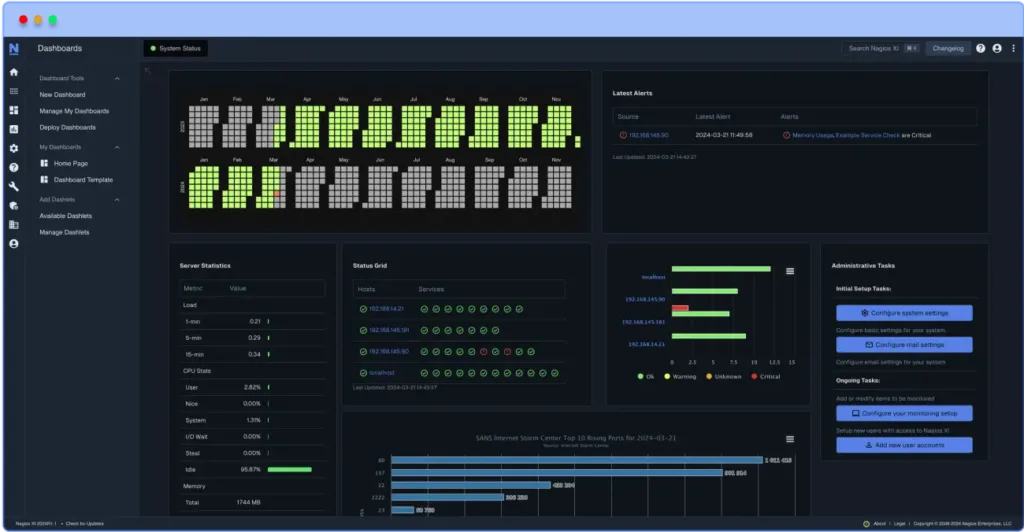
Modern on-prem solutions can scale very easily. Suitable for hybrid IT environments, Nagios XI streamlines expansion through built-in Wizards and auto-discovery tools, allowing you to onboard new systems effortlessly while keeping monitoring costs predictable.
2. Data Sovereignty
Cloud Advantage: Vendor-Managed Data
Cloud monitoring platforms centralize infrastructure data and offer cloud visibility, giving teams a single view across both cloud and on-prem environments. This simplifies monitoring but introduces security risks when vendors have access to your data.
The Trade-Off: Loss of Data Control
When you use cloud monitoring, your monitoring data (including infrastructure details, performance metrics, and alerts) lives on the vendor servers.
For organizations with HIPAA, GDPR, or other compliance requirements, this raises critical questions of where your data is stored and who has access to it.
The On-Prem Advantage: Full Data Sovereignty
With on-premises monitoring, your data never leaves your infrastructure. You maintain complete control over:
- Where data is stored
- Who can access it
- How long it’s retained
- Compliance with regulations like HIPAA, GDPR, and other compliance standards
Nagios XI’s on-premises monitoring helps support compliance with standards such as HIPAA, GDPR, and other regulatory standards.
And while your monitoring stays on-prem, it still provides full visibility into hybrid environments, including public and private cloud resources, while also keeping infrastructure data within your organization.
Real-Life Example:
The 2020 SolarWinds breach demonstrated that monitoring platforms can be compromised through supply chain attacks, which had affected approximately 18,000 organizations. While no deployment approach eliminates all risks, on-premises installations keep your monitoring data within your controlled environment rather than on shared vendor infrastructure.
3. Reduced Maintenance Burden
Cloud Advantage: Hands-Off Maintenance
Cloud providers handle patching, updates, and database tuning. New features and integrations deploy automatically without having to upgrade projects or keep track of maintenance windows.
The Trade-Off: Ongoing Subscription Costs
You’re paying continuously for that convenience through subscription fees that are subject to potential annual increases and lack the cost stability of a perpetual license.
The On-Prem Advantage: Predictable, Low-Cost Maintenance
Since on-prem is self-hosted, you control maintenance timing and scope. In Nagios XI, for example, you can schedule automatic updates and maintenance without recurring subscription costs.
4. Built-In Redundancy and Uptime
Cloud Advantage: Enterprise-Grade Resilience
Cloud-based monitoring means enterprise-grade disaster recovery and uptime SLAs without having to build it yourself.
The Trade-Off: Internet Dependency
Internet dependency creates potential failure points. When your connection drops, your monitoring visibility drops as well.
The On-Prem Advantage: Infrastructure Independence
On-prem deployments can even run in fully offline environments, ensuring visibility even when external connectivity is unavailable.
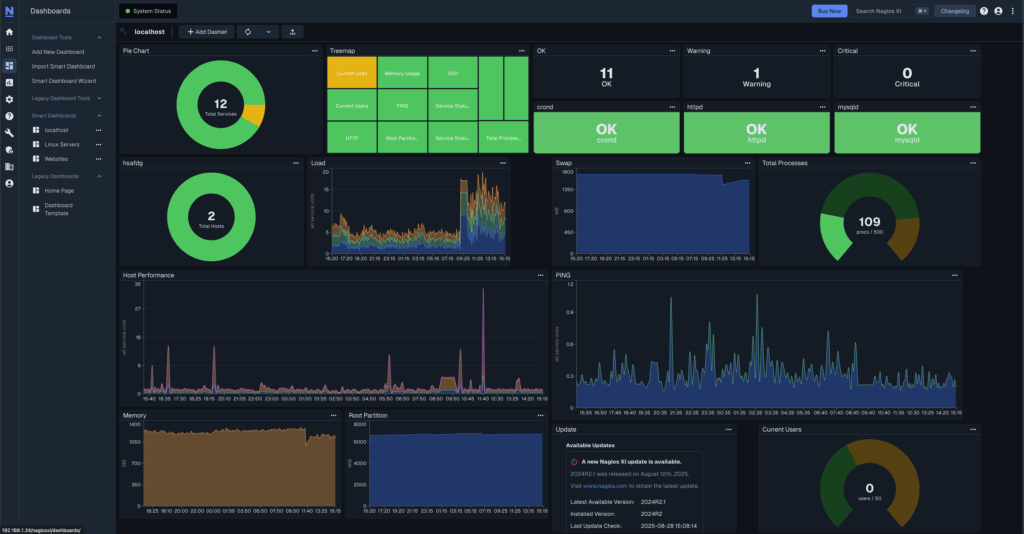
Modern on-prem solutions like Nagios XI support high-availability configurations and failover, giving you the same uptime protection without reliance on an external cloud provider.
5. Platform Independence and Customization
Cloud Advantage: Pre-Built Integrations
Cloud platforms often offer correlated insights, analyzing data across multiple systems and delivering vendor-driven recommendations.
The Trade-Off: Loss of Flexibility
With cloud-based software, you’re limited to integrations the vendor supports or allows through their APIs. If your infrastructure needs fall outside the platform’s design, you may be constrained by what’s possible within their ecosystem.
The On-Prem Advantage: True Platform Independence
With on-premises monitoring, you’re not trapped by the vendor’s roadmap or pricing model. You have:
- Custom Integrations: Full access to APIs, databases, and code. Build integrations with any system, without having to wait for vendor approval.
- Perpetual Licensing: A single upfront purchase grants permanent license ownership. Licensing costs remain consistent.
- Extensibility: Nagios XI in particular exemplifies this: the “XI” stands for “extensible insight.” The platform supports hundreds of community-developed plugins, custom API integrations, and direct database access. Organizations can build monitoring checks, create correlated insights across systems, integrate with legacy systems, and modify core functionality to fit their exact needs.
Nagios: 25+ Years of On-Premises Commitment
While the industry trend is shifting to subscription models, Nagios has maintained a different approach for over two decades.
Since pioneering the open-source Nagios Core in 1999, Nagios has since focused on on-premises deployment and perpetual licensing. This approach gives organizations ownership, predictable costs, and operational independence at a time when many vendors are locking customers into subscription models.
All four Enterprise Monitoring Solutions from Nagios are built on the foundation of Nagios Core, delivering predictable performance. Without internet dependency, on-premises monitoring delivers consistently reliable alerting and response times, which are critical for high-availability environments.
Making the Choice That’s Right for Your Organization
Circling back to the central question: should your organization follow the industry’s shift toward vendor-controlled cloud subscriptions or maintain infrastructure ownership with on-premises solutions?
The answer depends on your organization’s priorities, but if long-term control, cost stability, and data sovereignty matter most, on-premises solutions offer a clear advantage. Before deciding, it’s worth weighing a few key considerations:
- Calculate the true total cost over five to ten years, including infrastructure, personnel, opportunity cost, and potential subscription escalation. The numbers often reveal surprises.
- Prioritize vendor independence and platform flexibility. The next industry disruption is inevitable. On-premises solutions let you control when and how you adapt, without waiting for vendor approval or feature rollouts.
- Evaluate with realistic expectations. Every monitoring model involves trade-offs, but on-premises platforms provide predictable performance and control, helping you build a monitoring strategy that supports future growth.
With perpetual licensing, Nagios offers enterprise monitoring designed for organizations that value infrastructure ownership, data sovereignty, and long-term cost stability.
If you’d like to see how Nagios fits into your environment, start with a free trial and see the difference on-premises control can make.