





The IT infrastructure monitoring landscape is undergoing its most significant disruption in a decade. As major vendors shift to subscription-only models, organizations are facing skyrocketing costs, reduced operational control, and critical challenges to data sovereignty.
For IT leaders in highly regulated industries like healthcare, finance, and government, these transitions force an immediate decision: sacrifice cost predictability and compliance for vendor convenience, or embrace infrastructure ownership.
The Cost Crisis of Subscription Escalation
Beyond the initial price shock, subscription models introduce compounding financial and operational instability.
Hidden Costs That Undermine Planning
- Compounding Growth: Subscriptions typically include annual uplifts (often 5–10%) [1], creating compounding cost growth over multi-year contracts.
- Usage-Based Penalties: Subscription models penalize growth through per-device, per-user, or per-metric pricing that makes digital transformation initiatives increasingly expensive.
- Forced Migration Costs: When vendors eliminate perpetual licensing, organizations face professional services, training, and reconfiguration – often equal to or greater than the first-year subscription (commonly 1–3×, depending on complexity) [2].
- Negotiating Power Loss: Subscription dependence eliminates customer leverage, enabling vendors to implement price increases that would have been unthinkable under traditional licensing models.
Industry-Wide Vendor Shifts
The network monitoring market, valued at $3.7 billion in 2024 and projected to reach $8.2 billion by 2032 [3], is witnessing unprecedented vendor consolidation around subscription-only models. This transition follows a broader trend in enterprise software, where perpetual licenses are becoming rare.
- SolarWinds’ Transition: The move to Hybrid Cloud Observability ended perpetual licenses and standardized on subscription. Many customers reported pricing changes and reduced capacity at comparable spend.
- PRTG’s Elimination of Perpetual Licensing: In July 2024, Paessler ended perpetual licenses for PRTG Network Monitor.

The Case for Infrastructure Ownership
For organizations in healthcare, financial services, and government sectors, data sovereignty represents more than preference – it’s a regulatory requirement. The shift to cloud-based monitoring solutions introduces compliance issues that many organizations are unprepared to manage.
Regulatory frameworks like HIPAA, SOX, and PCI DSS often require specific data handling, storage, and access controls that become difficult when monitoring data flows through third-party cloud infrastructure. Many subscription-based solutions store data in shared cloud environments, creating conflicts with data residency requirements and cross-border regulations that can expose organizations to compliance violations.
Audits also become more difficult with cloud-based tools. Companies often rely on vendors’ logs and reports instead of their own data, which can lead to delays and raise concerns about accuracy.
The On-Premises Advantage:
- Complete Infrastructure Control: Organizations maintain full control over hardware specifications, security configurations, and data flow patterns, enabling customization that cloud solutions cannot match.
- Predictable Performance: Without internet dependency, on-premises monitoring delivers consistent, alerting and response times – critical for high-availability environments.
- Security Integration: On-premises solutions often integrate seamlessly with existing security frameworks, identity management systems, and network segmentation strategies.
CapEx Investment: A Superior Financial Model
Investing in monitoring infrastructure through capital expenses (CapEx) offers lasting advantages that grow even stronger as operating expense (OpEx) models like subscription-based and SaaS offerings keep rising.
| Cost of Ownership Comparison | Subscription Model | Independent Perpetual |
| Year 1 | $50,000 | $125,000 |
| Year 2 | $57,500 (15% increase) | $15,000 |
| Year 3 | $66,125 (15% increase) | $15,000 |
| Year 4 | $76,044 (15% increase) | $15,000 |
| Year 5 | $87,450 (15% increase) | $15,000 |
| Total 5-Year Cost | $337,119 | $185,000 |
| Savings | +$152,119 (45%) |
This CapEx approach is supported by the rising Cloud Repatriation Movement, where 83% of CIOs plan to move at least some workloads back in 2024 [4], with cost control being the primary driver. Organizations report 20% to 50% cost savings [5] when moving certain workloads off public cloud.
Data Sovereignty Benefits: Keeping monitoring infrastructure on-premises ensures sensitive data stays under organizational control, simplifying compliance and reducing external dependency.
Additional CapEx Advantages
- Asset Creation: Investments build tangible organizational assets that provide long-term capability.
- Depreciation Benefits: Capital investments can be depreciated over several years, offering substantial tax advantages.
- Economic Scaling: As organizations grow, CapEx monitoring scales more economically since expansion costs relate to hardware rather than usage-based licensing fees.
Compare approaches:
Nagios vs. SolarWinds – perpetual ownership, on-premises control, and total cost
Combating Subscription Fatigue
Subscription fatigue represents more than financial frustration. It creates dependence and stalls innovation. As costs escalate across the stack, IT leaders delay improvements to protect cash flow. Vendor roadmaps dictate capabilities, reducing flexibility. And when teams feel locked in, they become less willing to test new approaches.
Building Subscription Resilience Strategies
Portfolio Assessment: Evaluate subscription versus perpetual licensing balance across the entire technology stack, prioritizing CapEx investments in critical infrastructure components.
Strategic Vendor Partnerships: Focus relationships with vendors offering perpetual licensing options and demonstrated track records of stable, predictable pricing models.
Long term Financial Planning: Develop five-to-seven year technology roadmaps that account for subscription escalation patterns and plan strategic CapEx investments accordingly.
Building resilience means shifting the balance. Organizations that prioritize CapEx for critical infrastructure regain predictability, independence, and confidence in long-term planning.
The Link to Performance (MTTR)
Mean Time to Repair (MTTR) measures the average time required to restore system functionality following failure, encompassing detection, diagnosis, and resolution phases. MTTR includes the time from when the failure occurs to when the system or equipment is fully functional again, including time to detect failure, diagnose the issue and fix the problem.
MTTR Calculation:
MTTR = Total time spent on repairs / Number of repairs
Strategic monitoring infrastructure directly impacts MTTR through improved failure detection speed, enhanced diagnostic capability, and automated response systems.
The Business Impact of MTTR Optimization
Organizations that optimize MTTR through strategic CapEx monitoring investments realize measurable benefits:
- Enhanced Service: Improved service availability and customer satisfaction.
- Operational Efficiency: Teams shift from reactive firefighting to strategic initiatives.
- Reduced Downtime Costs: Every minute of system downtime carries a quantifiable cost impact, making MTTR reduction a direct contributor to business profitability and operational efficiency.
Related reading:
Understanding and Preventing the Cost of Downtime
Evaluating Perpetual License Alternatives
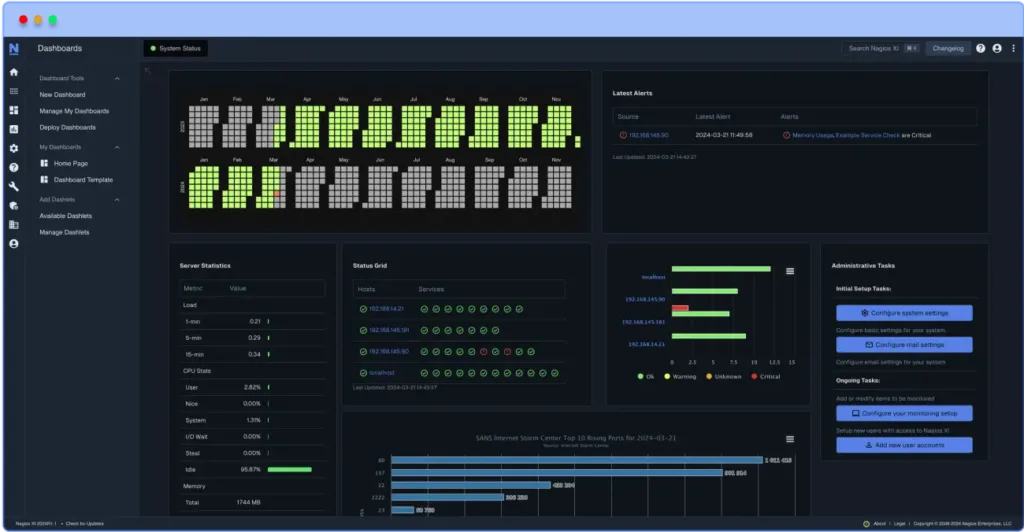
If you’re evaluating perpetual licensing options, or looking for a credible SolarWinds alternative, you’re likely prioritizing cost predictability, operational control, and enterprise-scale effectiveness. Nagios XI delivers on these fundamentals without the complexity often associated with other alternatives.
Different from open source solutions like Zabbix and Nagios Core that require significant internal expertise to deploy and maintain, or newer enterprise alternatives that may have scaling limitations, Nagios XI provides a mature platform that’s been proven in thousands of enterprise environments.
For organizations specifically migrating from SolarWinds or PRTG, Nagios offers dedicated migration tools and professional services that understand your current configurations. This means less disruption during transition and faster time to value in your new environment.
Taking Control of Your Monitoring Future
Market disruption has made change inevitable. The critical decision is whether to accept vendor dependence and escalating OpEx costs or to re-establish independence and cost control through CapEx investment in perpetual licensing.
The good news is that proven alternatives exist. Organizations across industries are successfully transitioning to perpetual licensing solutions that restore predictable costs and operational control. Nagios XI helps make that independence possible.
Sources and References:
[1] Enterprise software subscription annual increases
- Vertice: SaaS Inflation Index 2025 (pricing up materially YoY). https://www.vertice.one/l/saas-inflation-index-report
- CFO Dive: “SaaS prices outpace CPI inflation; 73% of vendors hiked prices (2023).” https://www.cfodive.com/news/stubbornly-high-saas-prices-outpace-cpi-inflation/699683/
[2] Vendor licensing transition / implementation services costs
- CAL Business Solutions (PDF) How to Estimate the Cost of ERP Implementation Services (recommends 1:1 to 1:1.5 software:services as a baseline). https://www.calszone.com/wp-content/uploads/Beyond-Software-How-to-Estimate-the-Cost-of-ERP-Implementation-Services.pdf
- 180 Systems – How much does an ERP software cost? (implementation frequently ≥ 1.5× license in mid-market). https://www.180systems.com/article/erp-costs/
[3] Network monitoring market valuation ($3.7 billion in 2024, projected $8.2 billion by 2032): Fortune Business Insights – “Network Monitoring Market Size, Share | Growth Report [2032]” (2024) – https://www.fortunebusinessinsights.com/network-monitoring-market-108432
[4] Cloud repatriation statistics (83% of organizations moving workloads off cloud): EE Times Europe – “Cloud repatriation on the rise: 83% of CIOs plan workload shifts in 2024” citing Barclays CIO Survey (2024) – https://www.eetimes.eu/cloud-repatriation-on-the-rise-83-of-cios-plan-workload-shifts-in-2024/
[5] Cost savings from repatriation (illustrative cases/analyses)
- a16z – The Cost of Cloud, a Trillion Dollar Paradox (analysis discussing 30–50% savings potential for certain workloads). https://a16z.com/the-cost-of-cloud-a-trillion-dollar-paradox/
- GeekWire – “Dropbox saved almost $75M over two years by building its own infrastructure” (S-1 detail). https://www.geekwire.com/2018/dropbox-saved-almost-75-million-two-years-building-tech-infrastructure/